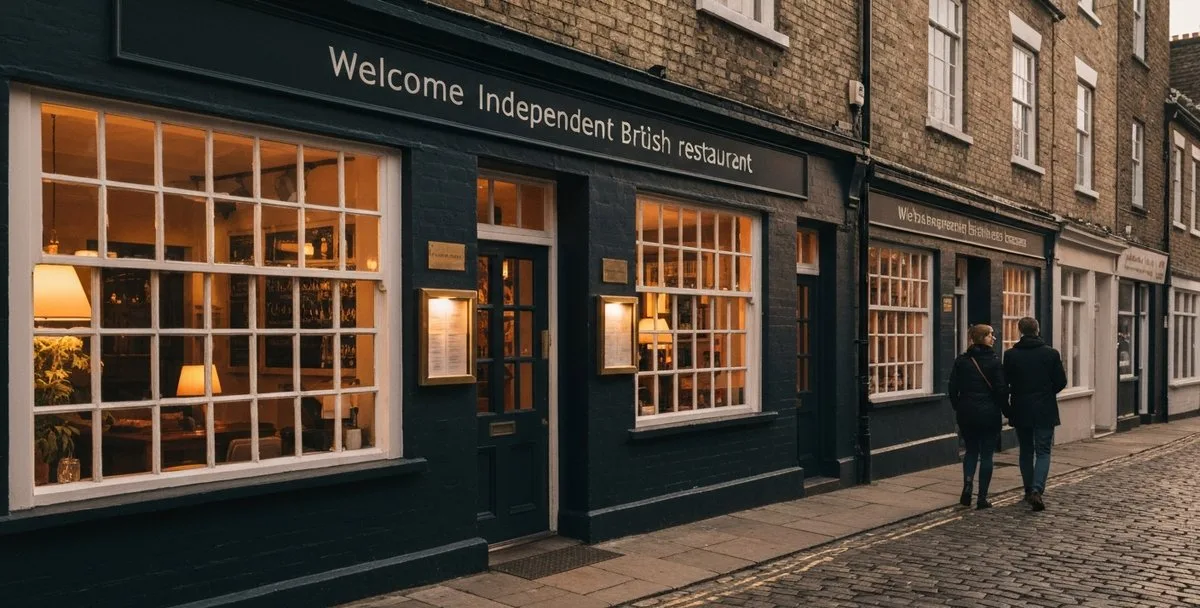
A well-built restaurant website that takes direct bookings and online orders will typically recover its build cost within 60 days. The reason is simple: Just Eat and Deliveroo charge UK restaurants 14–35% commission on every order. On a modest £8,000 monthly delivery turnover, that is £1,120–2,800 disappearing every month before you pay a single bill. A direct ordering page costs a fraction of that to run. This guide covers what UK restaurant websites need in 2026, how to get found on Google Maps, and what most restaurant owners get wrong when they build their first site.
The Aggregator Commission Problem
Just Eat, Deliveroo, and Uber Eats are useful for discovery. They put your restaurant in front of people who have never heard of you. The problem is what they charge once those customers find you — and keep charging every time those same customers order again.
Just Eat’s commission starts at around 14% for its basic tier but rises with promoted placement and added features. Deliveroo charges 25–35% depending on your agreement and location. Uber Eats sits in a similar range. These percentages come off gross order value — before food costs, packaging, or staff.
What the Maths Actually Looks Like
Say your restaurant does £10,000 a month in delivery orders, split roughly half through Deliveroo at 30% and half through Just Eat at 20%. That is £1,500 to Deliveroo and £1,000 to Just Eat — £2,500 a month, £30,000 a year, gone. A direct ordering system like Flipdish, Slerp, or OrderingHQ typically costs £49–150 per month plus standard card processing fees of around 1.4–2.5% via Stripe. Even if you only moved 20% of those orders to direct, you would save roughly £6,000 a year with a tool that costs under £1,800.
The website is the mechanism that makes direct ordering work. Aggregators own the customer relationship on their platforms — they collect the data, they control reordering, they send the marketing emails. Your own website hands that relationship back to you.
Keeping Aggregators While Building Direct
You do not have to leave Just Eat on day one. The practical approach is to use aggregators for acquisition — let them find new customers — and use your own website to retain those customers. When a new diner orders through Deliveroo, include a printed card in the bag with a QR code and a small discount code for ordering direct next time. Over six months, a meaningful share of repeat orders moves to your own platform.
What a Restaurant Website Must Have in 2026
Restaurant websites fail at the basics more often than any other sector we work in. The most common failure is a PDF menu. Google cannot read it, phones cannot display it legibly, and visitors on mobile leave before they find what they are looking for.
HTML Menus, Not PDFs
An HTML menu is a proper web page with items listed in text. Google indexes it, ranks it, and shows excerpts in search results. A visitor searching “Sunday roast Cardiff” could land directly on your Sunday menu page. A PDF gives you none of that. HTML menus also render instantly on every device, can include allergen filters, and are trivial to update without opening Acrobat.
For allergen information, HTML is not optional — it is required by law. Under the Food Information Regulations 2014 and the Food Information (Amendment) Regulations 2019 (“Natasha’s Law”, in force October 2021), food businesses must provide allergen information for every item. Online menus must clearly display the 14 major allergens listed by the Food Standards Agency. A locked PDF makes this nearly impossible to maintain.
Online Table Booking Integration
UK diners expect to book a table online. According to OpenTable, over 60% of UK restaurant reservations now come through digital channels. If your site sends diners to a contact form or a phone number, you lose every booking that happens outside your opening hours.
The main UK booking platforms are OpenTable, ResDiary, SevenRooms, Collins, and Resy. Each integrates via a widget or iframe that embeds directly into your website. Collins is particularly common in UK independent restaurants and gastropubs. The booking widget should appear on your homepage, your reservations page, and ideally on every key menu page so the path to booking is never more than one click away.
Direct Online Ordering
If you do delivery or collection, you need a direct order page. Flipdish, Slerp, and OrderingHQ all provide white-label ordering systems that look like your own brand. Customers see your menu, pay through your checkout, and the order lands in your kitchen — no third-party branding, no aggregator taking 25%.
The key is driving customers to that page. Your Google Business Profile ordering link, your social media bio link, and any email or SMS marketing you send should all point to your own order page, not a Deliveroo link.
Your Food Hygiene Rating
The Food Hygiene Rating Scheme (FHRS) operates across England, Wales, and Northern Ireland. A rating of 5 is a genuine trust signal — displaying it prominently on your website reduces hesitation from new visitors. In Wales and Northern Ireland, displaying the rating is a legal requirement. In England it is optional but strongly worth including for any rating of 3 or above.
We worked with an independent Cardiff restaurant that was doing £6,000 a month through Deliveroo and Just Eat at an average 28% commission — roughly £1,680 a month going out the door. We built them a direct order page using Flipdish and embedded it on a new custom website. Within four months, 35% of their repeat delivery customers had switched to ordering direct. Commission costs dropped from £1,680 to just under £900 a month. The website paid for itself in month two.
Local SEO: Getting into Google’s 3-Pack
The Google local 3-pack is the map block that appears at the top of searches like “Italian restaurant Cardiff” or “Sunday lunch near me.” Getting into it is the most valuable SEO result a restaurant can achieve, and it does not require you to outrank national publications or review sites. It requires a well-maintained Google Business Profile and a fast, well-structured website.
Google Business Profile for Restaurants
Your Google Business Profile (GBP) is the most powerful local ranking factor you control. For restaurants, the key fields are: correct category (use “Restaurant” as primary, add cuisine type as secondary), opening hours including special holiday hours, your menu link (point it to your HTML menu page, not a PDF), your online ordering link (point it to your direct order page), and a booking link (your reservation widget URL). Upload at least 20 photos — interior, exterior, food shots, team. GBP profiles with 20+ photos get significantly more direction requests.
Respond to every Google review, positive and negative. Google’s algorithm factors in review velocity and response rate. A restaurant with 80 reviews and consistent owner responses ranks above an equivalent one with 80 reviews and no engagement.
Schema Markup for Restaurants
Schema markup is code added to your website that tells Google precisely what kind of business you are. For restaurants, the relevant types are Restaurant (a subtype of FoodEstablishment), Menu, and MenuItem. Getting these right means Google can display your cuisine type, price range, and opening hours directly in search results without the user having to click through to your site. It also powers Google’s rich results for restaurant knowledge panels.
The minimum schema a restaurant website needs: Restaurant with name, address, telephone, openingHoursSpecification, servesCuisine, priceRange, and menu pointing to your HTML menu URL.
Mobile Speed Is Non-Negotiable
Around 70% of restaurant searches happen on mobile, often while the person is already out and deciding where to eat. Google uses mobile page speed as a ranking factor. A restaurant site that takes five seconds to load on a phone loses that customer to a competitor who loads in under two. Image compression, browser caching, and avoiding heavy JavaScript frameworks make the biggest difference.
Design Elements That Convert Visitors to Bookings
Good restaurant website design serves one purpose: getting visitors to book a table, place an order, or call ahead. Everything else — the aesthetic, the story, the About page — supports that goal but does not replace it.
Photography Carries More Weight Than Copy
Restaurant websites live or die on food photography. Stock photos of generic dishes do real damage. Visitors can spot stock photography immediately, and it undermines trust in the actual quality of your food. A single afternoon with a food photographer who specialises in hospitality work costs £300–700 and produces content that works across your website, social media, and Google Business Profile for years.
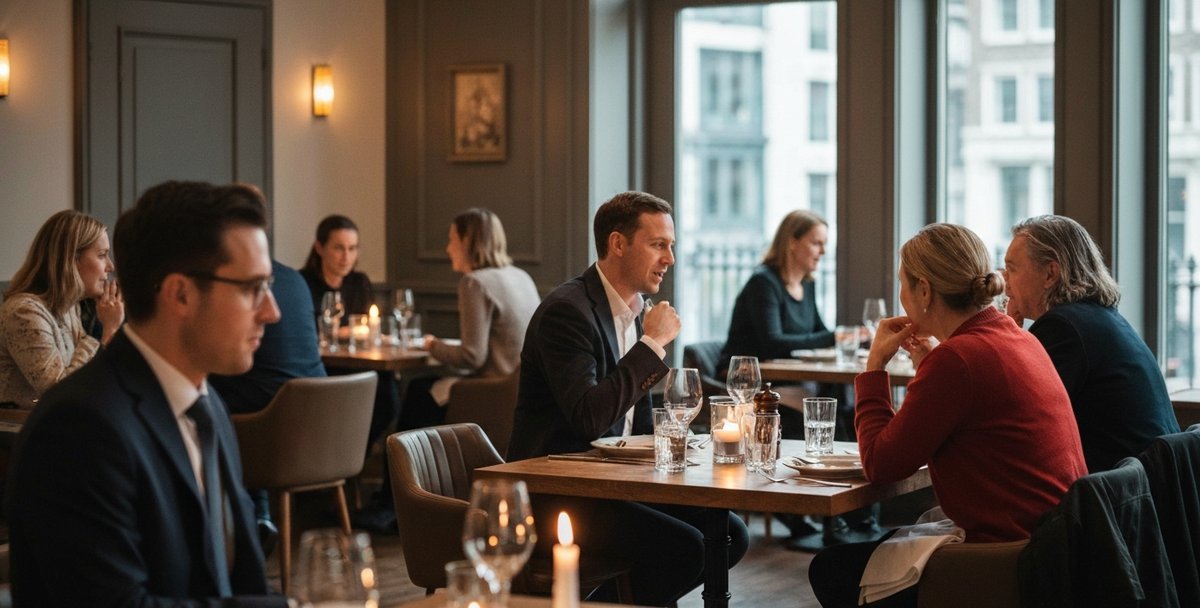
For the hero image on your homepage, choose something that shows the atmosphere of the space — a room full of diners, ambient lighting, a table set for a special occasion. Food close-ups work better on menu and individual dish pages. The goal of the homepage hero is not to make someone hungry; it is to make them want to be in that room.
The Booking Button Must Never Be Far Away
Every page on a restaurant website should have the booking or order call-to-action within easy reach — ideally in the header (sticky on scroll) and again at the end of each section. On mobile, a fixed bottom bar with a single “Book a Table” button is the highest-converting pattern we have seen. Remove friction: the button should open the booking widget directly, not navigate to a separate reservations page that then has the widget.
Pro tip: Enable “Reserve with Google” through your GBP — it puts a Book button directly in search results and on Google Maps so diners can book without visiting your site at all. OpenTable, ResDiary, and Collins all support this integration.
| Platform type | Build cost | Monthly cost | Direct ordering | Best for |
|---|---|---|---|---|
| WordPress custom | £2,500–5,000 | £20–60 (hosting) | Via Flipdish / Slerp plugin | Independents wanting full control |
| Squarespace / Wix | £0–500 (DIY) | £23–49 | Limited (Squarespace Online Ordering) | Very small cafes, no delivery |
| Lightspeed K-Series | £500–2,000 | £50–200 | Built-in | Mid-size restaurants with EPOS already |
| Bespoke web app | £15,000+ | £200+ (infra) | Full custom | Chains, multi-site groups |
Common Mistakes to Avoid
- PDF menu only — Google cannot index it, phones cannot read it legibly, and it cannot display allergens dynamically. Use HTML menus.
- No allergen information — a legal requirement under UK Food Information Regulations 2014. Missing allergen data is an FSA compliance failure, not just an oversight.
- Pointing GBP ordering link to Deliveroo — this drives traffic directly to an aggregator and costs you 25–35% on every order. Point it to your own order page.
- Slow image loading — uncompressed food photography kills mobile performance. Every hero and dish image should be converted to WebP and sized to its display width, not served at 4,000px.
- No booking system on mobile — 70% of restaurant searches are mobile. If your reservation widget is desktop-only or breaks on smaller screens, you lose the majority of would-be bookings.
- No opening hours in schema — without
openingHoursSpecificationin your structured data, Google will either show no hours in the knowledge panel or display wrong hours scraped from an old listing. - Generic food photography — stock images of food that does not reflect your actual menu erodes trust. One proper photography session outperforms any amount of stock library content.
7 Frequently Asked Questions
A professionally built restaurant website in the UK typically costs £2,500–6,000 for a custom WordPress site, including a bookings integration and HTML menu. Basic DIY builders like Squarespace or Wix can be set up for £0–500 upfront plus £23–49 per month, but they offer limited control over schema markup, page speed, and direct ordering integrations. If you add a direct online ordering system via Flipdish or Slerp, expect to pay an additional £49–150 per month. The commission savings on direct orders typically cover that cost within the first week of orders.
Yes. Under the UK Food Information Regulations 2014 and the subsequent “Natasha’s Law” amendment (October 2021), food businesses must clearly provide information on the 14 major allergens listed by the Food Standards Agency for any food they sell. For restaurants, this means your online menu must identify which dishes contain celery, cereals containing gluten, crustaceans, eggs, fish, lupin, milk, molluscs, mustard, peanuts, sesame, soybeans, sulphur dioxide and sulphites, and tree nuts. A PDF menu makes this practically difficult to maintain and verify. An HTML menu with per-item allergen labels is the correct approach.
For independent UK restaurants, Collins and ResDiary are the most commonly used booking platforms because they are built specifically for the UK hospitality market and integrate with most EPOS systems. OpenTable has better name recognition (particularly useful if overseas visitors book through it) and supports “Reserve with Google.” SevenRooms is popular with higher-end restaurants that want detailed guest profiles and CRM features. Resy is growing in the UK but remains stronger in the US. All of them provide embeddable booking widgets that sit natively on your website. The right choice depends on your EPOS, your typical cover size, and your budget for the monthly subscription.
The Google local 3-pack is primarily driven by three things: Google Business Profile completeness and accuracy, proximity of the searcher to your restaurant, and the volume and recency of your reviews. For completeness: fill in every field in GBP (hours, categories, photos, menu link, ordering link, booking link), post at least once a fortnight, and respond to every review. For reviews: ask every table for a Google review at the end of a visit using a short URL or QR code. For your website: make sure your name, address, and phone number match exactly between GBP, your website, and any directories (Yell, TripAdvisor, DesignRush). Schema markup (Restaurant type) on your website reinforces the relevance signals Google is picking up from GBP.
Squarespace suits a café or small restaurant that wants a presentable site quickly and has no plans to add direct ordering, custom booking flows, or multiple menu sections with allergen filtering. It has a gentle learning curve and adequate photo presentation. WordPress is better if you want full control over schema markup (critical for Google rich results), fast custom menu pages, direct ordering integration via a plugin, and no platform dependency. The main limitation of Squarespace for restaurants is that its schema output is generic and its online ordering is basic. If delivery or complex menus are part of your business, WordPress with a proper build is worth the additional upfront cost.
Photography is the single highest-ROI investment a restaurant website can have after getting the booking system right. Visitors make a decision about your restaurant in under three seconds. Stock photos of generic dishes signal inauthenticity immediately. A four-hour session with a hospitality food photographer in the UK costs £300–700 and produces content usable across your website, Google Business Profile, Instagram, and printed menus for two to three years. On your website, prioritise an atmospheric room shot for the homepage hero (it sells the experience), dish photography on menu pages (it sells the food), and a short video or image of your team for the About section (it sells the people).
At minimum, a restaurant website should implement the Restaurant schema type (a subtype of FoodEstablishment) with these properties: name, address (with full PostalAddress), telephone, openingHoursSpecification (separate entry per day or grouped), servesCuisine, priceRange (e.g. “££”), menu (URL of your HTML menu), acceptsReservations (true), url, and image. If you have online ordering, add hasMenu with a Menu object. If you have multiple locations, give each a separate Restaurant entity. Schema is delivered as JSON-LD in the page <head> — not as microdata embedded in the HTML body. Google’s Rich Results Test at search.google.com/test/rich-results will confirm it is reading correctly.
Need a restaurant website that takes direct bookings, runs your own online ordering, and actually shows up on Google Maps? At Cambria Digital we build custom restaurant sites for UK hospitality businesses — no templates, no platform lock-in, no aggregator dependency baked in. Book a free 30-minute call and we will walk through your current setup and what a direct ordering system would realistically save you. You can also read more about our UK website design service to see how we approach the build.