
- The Short Answer — 4 YES and 4 NO Signals
- What Google Ads Actually Cost in the UK (2026)
- The ROI Math — Does the Spend Pay Back?
- Google Ads vs SEO — Which Comes First for UK SMBs?
- How Much to Budget by Business Size
- When Google Ads DO Work
- When Google Ads DON'T Work
- The 90-Day Google Ads Results Curve
- DIY vs Agency — When to Switch
- The 12-Point Readiness Checklist
- Frequently Asked Questions
The Short Answer — 4 YES and 4 NO Signals
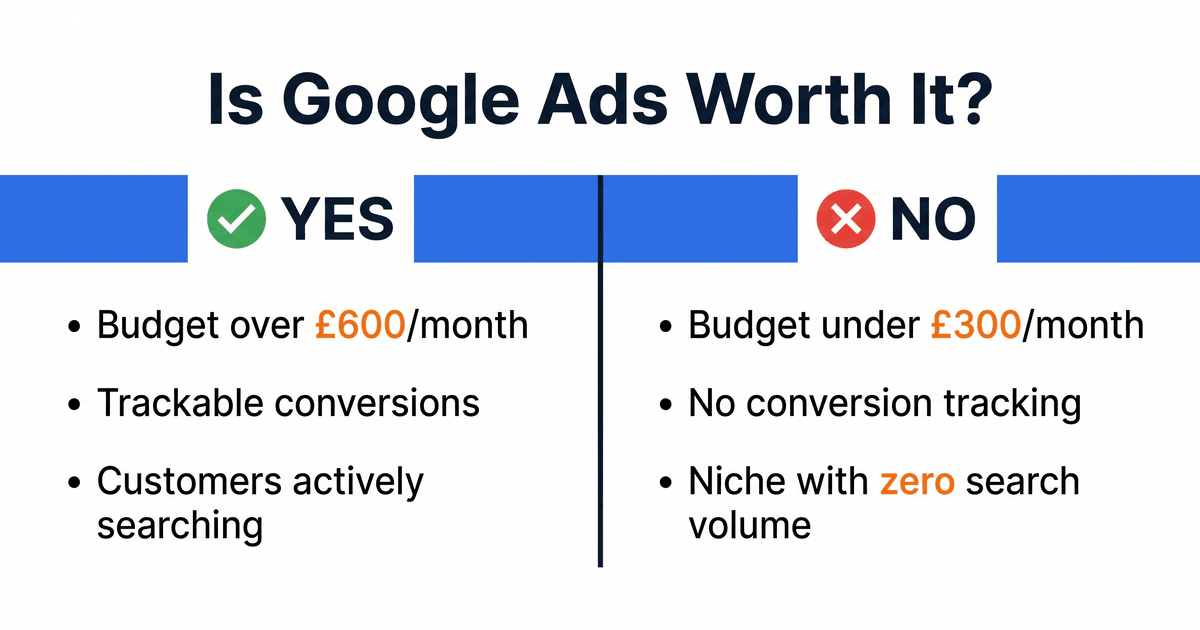
Google Ads are worth it for UK small businesses that have a monthly budget of at least £600, conversion tracking set up properly, a product or service with real search demand, and a plan to stick with it for 90 days minimum. If any one of those four is missing, Google Ads will burn money. The math is unforgiving: below £300 a month you cannot gather enough data for the algorithm to learn, and without conversion tracking you are optimising for clicks instead of leads.
This guide does three things most UK Google Ads articles skip. It gives you a straight YES or NO decision framework instead of "it depends" waffle. It shows the actual ROI math with UK numbers — CPCs, conversion rates, and realistic payback periods. And it ends with a 12-point readiness checklist you can score in 15 minutes before you spend a penny. The numbers below come from managing real UK accounts at Cambria Digital since 2017.
A Cardiff retailer once emailed us asking why her £400 monthly Google Ads budget generated zero sales in three months. The diagnosis took ten minutes: her campaign bid on the phrase "buy running shoes", a keyword dominated by Nike, Asos, and Sports Direct, each spending six figures a month. She had no conversion tracking, no negative keywords, and Smart Bidding kept optimising her clicks toward the cheapest, worst-fit traffic. This scenario plays out hundreds of times a week across UK small businesses. Reading this guide before you launch is the single cheapest mistake-prevention you can buy.
The 4 YES Signals
If you tick all four of these, Google Ads almost always pay back. Budget of £600 per month or more — enough for the algorithm to learn and for you to see statistically meaningful data. Trackable conversions — a form submit, phone call, or purchase you can verify ended up as revenue. Product or service with active search intent — people are typing your solution into Google, not just hoping to stumble across it on Instagram. Commitment of 90 days minimum — campaigns that run less than 90 days never get out of the learning phase.
The 4 NO Signals
If you tick any one of these, stop and rethink. Budget below £300 per month — you will hit an impression-share wall before the algorithm learns. No conversion tracking — you are flying blind and Google's algorithm will optimise for the wrong outcome. Niche with no search volume — if nobody searches for what you sell, Google Ads cannot help you. Try content, social, or direct outreach instead. You need leads this week — Google Ads takes 6 to 12 weeks to reach efficient cost per acquisition. If the pressure is that tight, hire an outbound team, not an ads platform.
What Google Ads Actually Cost in the UK in 2026
UK Google Ads spend breaks into two layers: what you pay per click, and what you pay overall per month. Both move with industry, keyword intent, and quality score. Here are the 2026 benchmarks from managing UK accounts across web development, legal, ecommerce, and professional services.
UK Cost-Per-Click (CPC) Benchmarks by Industry
| Industry | Typical UK CPC | Comments |
|---|---|---|
| Ecommerce (general retail) | £0.50 – £1.50 | Shopping ads cheaper than Search |
| Local services (plumber, electrician, hair) | £2 – £5 | Depends heavily on city |
| B2B SaaS / software | £4 – £10 | High-intent but competitive |
| Legal services | £15 – £40 | Personal injury pushes £60+ per click |
| Insurance, finance, mortgages | £20 – £50 | Most expensive UK vertical |
| Web design / digital agency | £4 – £9 | Varies by city modifier |
| Mobile app development | £12 – £25 | B2B buyer, high AOV deals |
Typical UK Monthly Spend
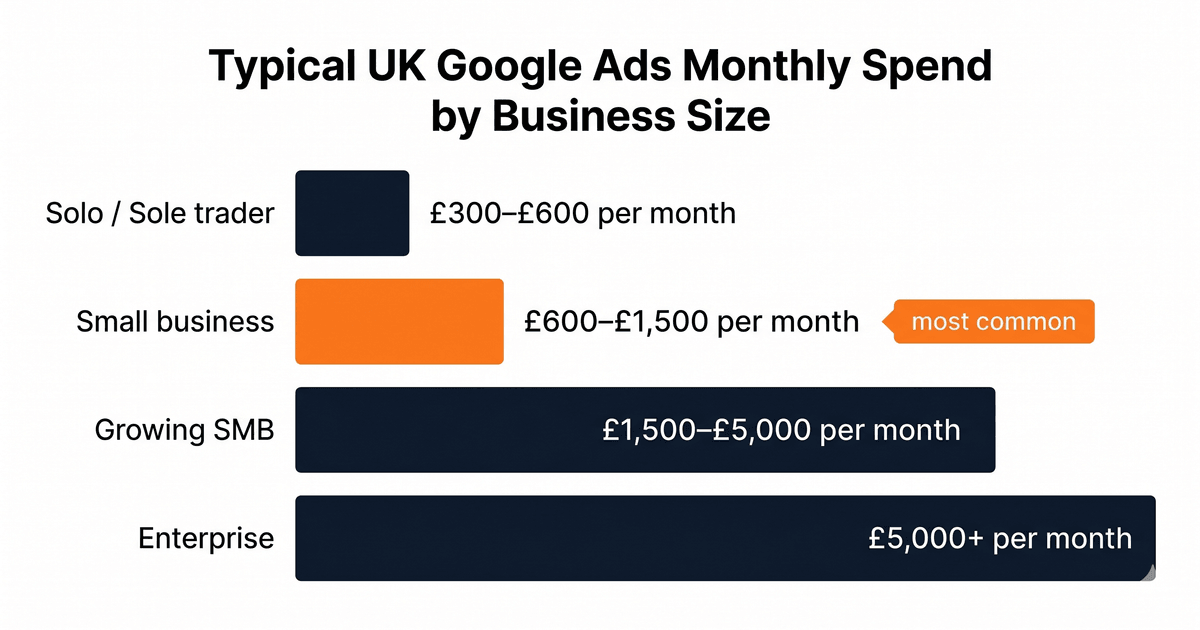
Most UK small businesses land in three spend bands. The sweet spot for SMB lead-gen is £600 to £1,500 per month — enough data for the algorithm to learn, small enough to control. Below £600 you starve the algorithm. Above £5,000 you need dedicated management, not a weekend-evening tweak cycle.
The Hidden Costs Most UK Guides Skip
Headline click cost is only half your actual spend. Add these to the budget conversation before you launch.
- Agency management fee — 10% to 20% of ad spend, or a flat retainer of £400 to £2,000 per month.
- Landing page build or optimisation — £500 to £3,000 one-off if your site isn't already conversion-ready.
- Conversion tracking setup — £300 to £800 for proper GA4 plus Google Ads tags plus Consent Mode V2, unless you have someone in-house.
- Call tracking — £30 to £150 per month if phone is a primary conversion type (we recommend CallRail or Google's forwarding numbers).
- Creative — £200 to £1,000 for initial ad copy variants, image assets, and sitelink extensions.
Add 20 to 35 percent to your raw ad spend for everything outside the ad platform itself. A "£1,000 a month" campaign realistically costs £1,300 to £1,600 all-in. Every UK agency quote that skips this math is setting you up for sticker shock in month two.
The ROI Math — Does the Spend Pay Back?
The question "is Google Ads worth it" always comes down to one calculation: does each pound you spend return more than a pound in profit? Here is the real UK math, worked through an SMB example.
The Formula
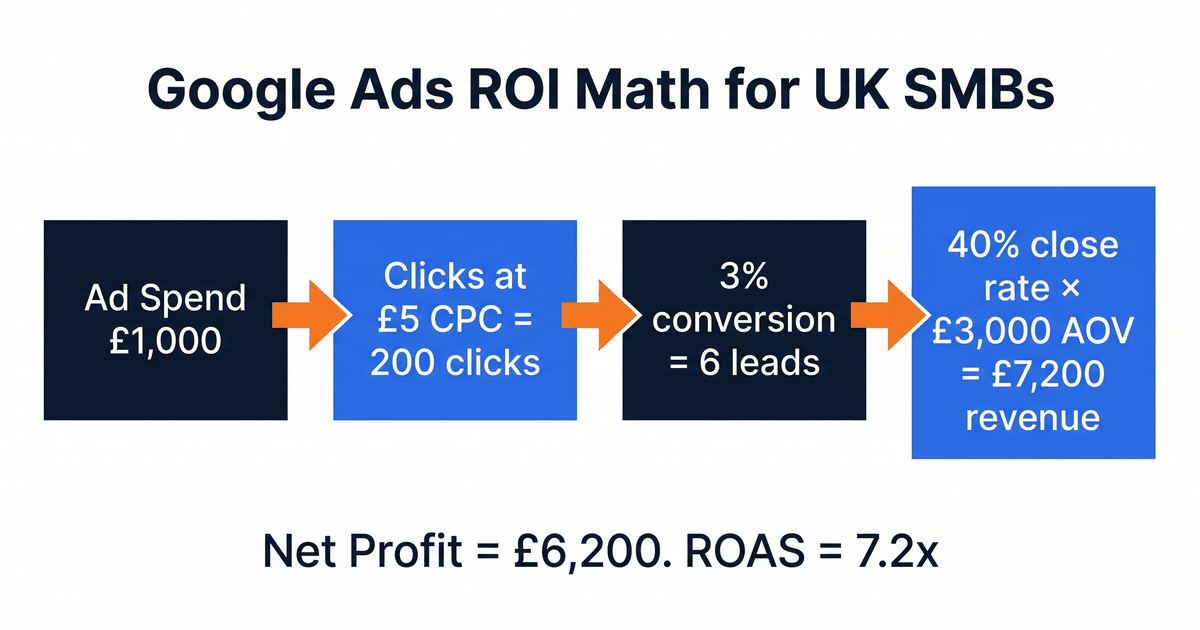
Ad Spend → Clicks → Leads → Customers → Revenue. Five variables decide whether the math works. Most UK SMBs get two of the five wrong on their first campaign.
Worked Example: A UK Web Design Agency
Assume £1,000 monthly ad spend. UK web-design CPC sits around £5 per click. That buys 200 clicks in the month. With a decent landing page and clear conversion path, 3 percent of clicks convert to leads — that is 6 enquiries. A 40 percent close rate on those enquiries produces 2.4 new customers. At the £3,000 average deal size in UK SMB web design, that is £7,200 in revenue from £1,000 in spend. After ad costs and delivery, net profit lands around £4,500 to £5,500 depending on delivery margin. Return on ad spend (ROAS) is 7.2x.
When the Math Breaks
The same £1,000 breaks fast if any variable slips. At £8 CPC (tough vertical), clicks drop to 125. At 1 percent conversion rate (generic landing page), leads drop to 1.25. At 20 percent close rate (weak sales process), new customers drop to 0.25. That is £12 revenue on £1,000 spend — you lose £988. The lesson is not that Google Ads don't work. The lesson is that Google Ads amplify the rest of your funnel. If any stage is broken, Google Ads will find the break and make it expensive.
Pro tip: Before you launch, calculate your break-even ROAS. If your average deal is £3,000 with a 40% delivery margin, you make £1,200 profit per sale. You can afford up to £1,200 in ad spend to acquire one customer before you lose money. Divide that by your expected conversion rate × close rate to find your maximum bid. Every UK campaign that works has done this math upfront.
Google Ads vs SEO — Which Comes First for UK SMBs?
The honest answer most UK agencies won't give: you cannot properly run both in the same quarter on a sub-£2,000 monthly budget. Pick one for the first six months, then layer the second once the first is working.
Google Ads First — When This Is Right
Pick Google Ads if you need leads in the next 90 days, your site has active search demand, and you can afford £600 plus per month for at least three months. Ads start delivering leads within 7 to 14 days of launch. SEO takes 4 to 9 months before the first meaningful traffic lands. If cashflow needs leads now, Google Ads is the only realistic answer.
SEO First — When This Is Right
Pick SEO if you have 6 to 12 months of runway without needing paid-search leads, you sell a high-lifetime-value service, and you want to build an asset that compounds. SEO traffic at month 12 costs 80 percent less per lead than Google Ads. But you need patience, and the patience kills most SMBs before they see the payback. SEO also wins for content-heavy niches where buyers research for weeks before they buy.
The Honest Both-Answer
If you can afford £3,000 plus per month in combined spend, run both. Google Ads buys you immediate lead flow while SEO builds the long-term compounding asset. The Google Ads data (which keywords convert, which landing pages work) feeds the SEO strategy, and the SEO content gives Google Ads better quality scores. This is how mature UK agencies like ours run campaigns — paid-search budgets fund SEO content that then reduces paid-search dependency over 18 months.
How Much to Budget by Business Size
Four realistic UK budget tiers based on business stage. Each tier has a sweet spot and a trap to avoid.
| Tier | Monthly spend | Right for | Biggest risk |
|---|---|---|---|
| Solo / Sole trader | £300 – £600 | Testing a single service or location | Not enough volume to learn — below algorithm threshold |
| Small business | £600 – £1,500 | Steady lead-gen for established SMB | DIY time-drain vs agency fees |
| Growing SMB | £1,500 – £5,000 | Scaling proven campaigns into new markets | Premature expansion before unit economics prove out |
| Enterprise | £5,000+ | Multi-location, multi-product, multi-channel | Attribution complexity — need proper data stack |
Why Under £300 Rarely Works
Google Ads' machine learning needs conversion data to optimise. Under £300 a month on a £5 CPC, you buy 60 clicks. At a 3 percent conversion rate, that is 1.8 conversions in a month — far below the statistical threshold for the algorithm to learn. Smart Bidding alone needs 30 conversions in 30 days to work properly. Below that threshold, you are paying to train Google's algorithm for free without any of the benefit.
When Google Ads DO Work — 4 Green-Light Scenarios
Patterns we have seen consistently at Cambria Digital where Google Ads generated strong ROAS from month one.
- Local service businesses with urgent-intent keywords — "emergency plumber cardiff", "24 hour locksmith bristol". Near-buyer intent, local pack dominance, high CPA ceiling because jobs close fast at £200 to £500 AOV.
- High-ticket B2B services with defined buyer persona — "Flutter app development UK", "ecommerce agency manchester". Long sales cycle but one closed deal pays back 3 to 6 months of ad spend.
- Ecommerce with a proven bestseller — Shopping ads on a product that already converts organically. Google Ads just amplifies what is already working.
- Seasonal or event-driven offers — wedding venues booking January-February, accountants in March before tax year-end, landscapers in March-April. Short sharp spend windows with clear ROI attribution.
When Google Ads DON'T Work — 4 Red-Flag Scenarios
The four patterns where we tell prospects honestly: save the money, Google Ads is not your answer.
- Brand-new concept with no existing search demand — if nobody types your product name or problem-description into Google, ads have nothing to bid on. Social content or PR works better here.
- Sub-£300 monthly budget — algorithm cannot learn, clicks too expensive per opportunity, data too thin to improve. Spend the same money on one high-quality blog post that will rank for 2 years.
- Broken conversion funnel — ads driving clicks to a slow, confusing site. Fix the site first. Ads amplify existing conversion rates, they do not create them.
- Expectation of month-one profit — algorithm learning phase takes 6 to 12 weeks minimum. If you need cash ROI in 30 days, ads are the wrong tool. Hire a commission-based salesperson instead.
The 90-Day Google Ads Results Curve
Every UK campaign we run follows roughly the same shape. Setting expectations correctly at launch prevents the single biggest failure mode — killing a campaign before it has a chance to work.
| Phase | What happens | What to do |
|---|---|---|
| Days 1-14 (Learning) | High CPC, low quality score, random conversion pattern | Do not change bids. Let the algorithm learn. |
| Days 15-45 (Calibrating) | CPA halves, quality score climbs, winning keywords emerge | Add negatives weekly, pause worst ad copies |
| Days 46-75 (Optimising) | CPA stabilises near target, scale tests begin | Increase budget on winning ad groups by 20% weekly |
| Days 76-90 (Profitable) | CPA at or below target, consistent lead flow | Lock in bid strategy, plan scale or add second campaign |
Campaigns killed at day 21 are killed mid-learning. Campaigns judged at day 90 are judged fairly. Most UK SMBs who report "Google Ads didn't work for us" killed campaigns at day 14 to 30. The ads didn't fail. The patience did.
At Cambria Digital we run our own Google Ads for services like web development and mobile apps in Cardiff. The first 30 days of our Web Design Cardiff campaign had CPA running at £280 — well above the £100 Month 3 target. A less patient operator would have paused it. By Day 60, after adding 47 negative keywords and two landing-page variants, CPA dropped to £165. By Day 90 it hit £92, below target. Same budget, same keywords, just time for the algorithm to learn. The patience saved roughly £400 of spend it would have taken to relearn later.
DIY vs Agency — When to Switch
Running Google Ads in-house saves 10 to 20 percent of ad spend in agency fees. It also costs 6 to 10 hours a week of founder time and 2 to 4 weeks longer to reach target CPA. Four thresholds determine when DIY stops being worth it.
Stay DIY If
Your monthly spend is under £1,500, you have Google Ads basics (keywords, negatives, Quality Score) at a working level, you can commit 4 plus hours per week, and you have conversion tracking wired up. At that scale, agency fees eat too much of your margin.
Hire an Agency If
Monthly spend passes £1,500, founder time is worth more than £80 per hour, you need advanced features (Smart Bidding, RSAs, Performance Max audiences), or you have tried DIY for 3 plus months and CPA is above target. A competent UK agency pays for itself in month two by avoiding the common DIY mistakes (broad match overspend, no negatives, bidding on brand).
What UK Google Ads Management Costs
Independent freelance PPC managers charge £400 to £900 per month for SMB accounts. Mid-market UK agencies charge 15 percent of ad spend with a £750 minimum. London enterprise agencies charge 20 percent plus £2,000 minimum. At Cambria Digital, Google Ads management sits inside our SEO & Marketing retainer from £499 per month (Essentials tier) through £1,999 per month (full suite including SEO, content, and Ads).
The 12-Point Google Ads Readiness Checklist
Score your business out of 12 before you spend a penny. A score of 10 or higher means launch. A score of 7 to 9 means fix the gaps first. Below 7 means Google Ads is not yet the right investment.
- Do you have at least £600 per month in reserved ad budget for 3 months?
- Can you name your top 5 competitors ranked by Google Ads spend in your niche?
- Is Google Analytics 4 installed and tracking the pages you want to convert on?
- Is conversion tracking set up for at least one primary goal (form, call, purchase)?
- Is Consent Mode V2 configured so cookies fire only after user consent?
- Does your landing page load in under 2.5 seconds on mobile?
- Does your landing page have one clear primary call-to-action above the fold?
- Do you have at least 20 target keywords, each with real UK search volume?
- Do you have an initial list of 50 negative keywords to block wasted clicks?
- Can you answer every competitor objection on your landing page?
- Do you have 3 to 5 ad headlines and 2 descriptions written and approved?
- Do you have a plan for the 90-day learning curve and won't kill the campaign at day 14?
Score 10 or above, launch with confidence. Score 7 to 9, fix the gaps — it takes 1 to 2 weeks and saves 3 to 6 weeks of wasted spend. Score 6 or below, invest in the fundamentals first. Google Ads does not fix a broken funnel; it exposes it.
Common Google Ads Mistakes UK SMBs Make
- Broad-match keywords without strong negatives — Google matches you to wildly irrelevant queries; budget evaporates in days.
- Bidding on your own brand when you already rank #1 organically — paying for clicks you would have got free, though sometimes worth it to block competitor bidding.
- No conversion tracking — you optimise for clicks instead of leads, and the algorithm happily finds the cheapest clicks that never convert.
- Sending ads to the homepage instead of a dedicated landing page — halves conversion rate minimum, kills Quality Score.
- Killing campaigns at day 14 — mid-learning phase; the ads didn't fail, the patience did.
- Running Search, Display, and YouTube in one campaign — impossible to diagnose which channel is working; Google's defaults actively hurt you.
- Ignoring the Search Terms report — this is where negative keywords come from; skipping it is like flying without instruments.
- No call-tracking when phone is a primary conversion — attribution data is wrong; Smart Bidding optimises the wrong signals.
8 Frequently Asked Questions
Yes, for UK small businesses that have a monthly budget of at least £600, conversion tracking properly set up, a product or service people actively search for, and a 90-day commitment. Under any of those four conditions, Google Ads rarely pays back. The math is unforgiving below £300 per month because the algorithm cannot gather enough conversion data to learn. With the right setup, UK SMB campaigns typically reach 3x to 7x return on ad spend within 90 days, depending on industry, landing page quality, and close rate.
UK Google Ads spend depends on business size and industry. Sole traders typically spend £300 to £600 per month, small businesses £600 to £1,500, growing SMBs £1,500 to £5,000, and enterprises £5,000 and up. Add 20 to 35 percent on top of raw ad spend for agency management fees, landing page optimisation, conversion tracking setup, and call tracking. A £1,000 campaign realistically costs £1,300 to £1,600 all in. Below £300 per month the algorithm lacks the conversion data to learn, so it rarely pays back.
Google Ads first if you need leads in the next 90 days and have £600 plus per month for 3 months. Ads deliver leads in 7 to 14 days; SEO takes 4 to 9 months. SEO first if you have 6 to 12 months of runway and want a compounding asset — by month 12 SEO traffic costs 80 percent less per lead than Google Ads. Above £3,000 per month combined spend, run both — Google Ads delivers immediate revenue while SEO builds the long-term asset that eventually reduces paid-search dependency.
UK CPC varies massively by industry. Ecommerce retail runs £0.50 to £1.50 per click (Shopping ads cheaper than Search). Local services like plumbers and electricians run £2 to £5. B2B SaaS sits at £4 to £10. Legal services run £15 to £40, with personal injury at £60 plus. Insurance and finance top the list at £20 to £50 per click. Web design agencies see £4 to £9. Mobile app development runs £12 to £25. These are UK-specific 2026 benchmarks; CPCs have risen roughly 15 to 25 percent year-on-year since 2022.
Yes — when the four readiness signals are in place (budget of £600 plus, conversion tracking, real search demand, 90-day commitment). UK small businesses in our experience typically hit 3x to 7x ROAS within 90 days of a properly set-up campaign. The most common failure mode is killing campaigns during the 6 to 12 week learning phase before the algorithm has optimised. Local services and high-ticket B2B consistently produce the strongest SMB returns because urgent intent and big deal sizes allow higher CPA ceilings.
£600 per month is the realistic UK minimum for Google Ads to work properly. Below that threshold, the algorithm cannot gather the 30 conversions in 30 days it needs to optimise Smart Bidding. £300 to £600 can work for very targeted campaigns in low-CPC niches (ecommerce, local services) if you pair it with manual bidding and tight keyword control. Below £300, you are funding Google's learning algorithm without any of the benefits; spend the money on organic content or social media instead.
Impressions and clicks start within 7 days of launch. Meaningful lead flow begins at days 15 to 30 as the algorithm calibrates. Target cost per acquisition is typically reached at days 60 to 90. Campaigns killed before day 45 are killed during learning phase and rarely give a fair assessment. The 90-day results curve is: Days 1-14 learning, Days 15-45 calibrating, Days 46-75 optimising, Days 76-90 profitable. Most UK SMB reports of "Google Ads didn't work for us" come from campaigns stopped before Day 45.
Run in-house if monthly spend is under £1,500, you have basic Google Ads knowledge, and you can commit 4 plus hours per week. Hire a UK agency if spend passes £1,500, your time is worth more than £80 per hour, you need advanced features like Smart Bidding or Performance Max, or DIY has not hit target CPA after 3 months. UK agency fees sit at 10 to 20 percent of ad spend or £400 to £2,000 per month retainer. At that scale, agencies typically pay for themselves in month two by avoiding the expensive DIY mistakes (broad-match overspend, missing negatives, weak Quality Score).
Ready to decide if Google Ads fits your UK business? Our Cardiff team runs a free 30-minute readiness call where we review your site, keywords, budget, and conversion funnel, and give you an honest yes or no with the math behind it. No hard sell, no "starting from" pricing that balloons in month two. Book your free readiness call or explore our SEO & Marketing retainers from £499 per month if you want us to manage the whole campaign end-to-end.